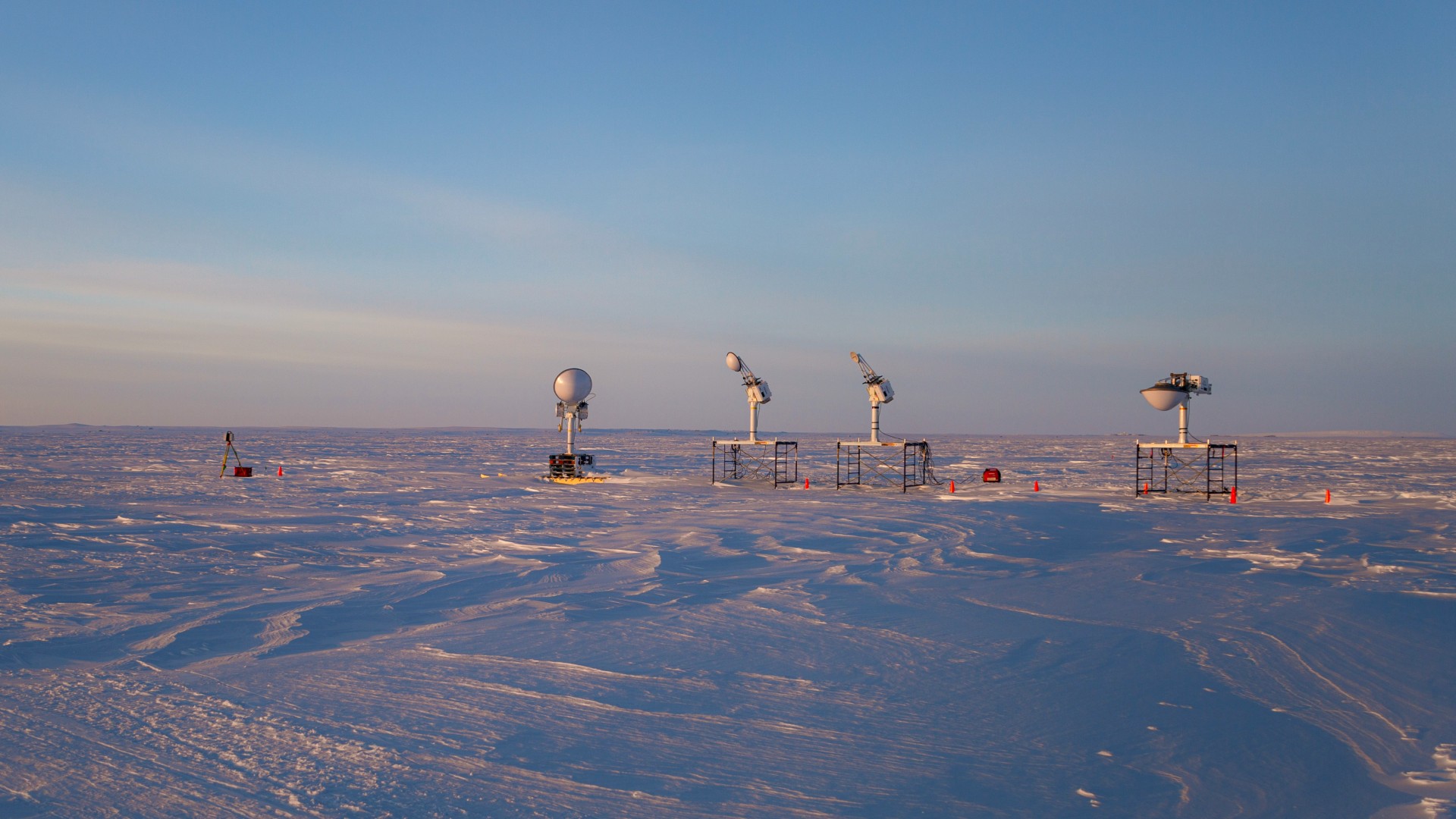
When the wind picks up across the sea ice outside Cambridge Bay in northern Canada, the wind chill can make it feel like minus 40°C.
Researchers dressed in heavy winter gear move between radars, drilling equipment and scientific instruments on the frozen sea. Masts and antennas are positioned directly on the ice. Above them, satellites pass overhead in orbit, while research aircraft and helicopters fly low across the sky.
Here, north of the Arctic Circle in Canada's Nunavut territory, DTU Space researchers have spent the past several months participating in a major international sea-ice measurement campaign. The effort is being carried out in collaboration with the European Space Agency (ESA), NASA and Canadian partners.
The work will help researchers improve their ability to monitor changes in the Arctic from space and understand how snow and sea ice evolve as the climate changes.
As sea ice continues to decline due to global warming, accurate measurements of that decline have become more important than ever. To obtain a precise picture, however, measurements must also be taken directly on the ice itself.
“When sea ice is changing as rapidly as we are seeing today, it becomes crucial that satellites can provide reliable observations over long periods of time. That means we need a very precise understanding of how snow and ice affect satellite signals,” says Associate Professor Rasmus Tage Tonboe from DTU Space, one of the leaders of the field measuring campaign.
The measurements collected on the ice have been combined with observations from aircraft and satellite data. Aircraft have flown along the same tracks observed by satellites, while researchers have been transported out on the sea ice by helicopter to conduct detailed measurements directly on the surface below.
All data are now being assembled into a comprehensive reference dataset that will be used to improve the models and methods behind future satellite measurements of sea-ice thickness, snow depth and sea-ice extent.
A central role for DTU
The campaign is part of ESA's SUPFIX-POLAR CEMSIE project (Copernicus Expansion Missions Sea Ice Experiment), which brings together researchers and engineers from Europe, Canada and the United States to develop more accurate methods for satellite observations of the polar regions.
DTU Space plays a central role in the project.
“We are making measurements on the ice, from aircraft and from satellites simultaneously. This gives us a truly unique dataset that allows us to compare our observations directly and understand how satellites observe snow and sea ice,” says Rasmus Tage Tonboe, Co-Principal Investigator (Co-PI) on the CEMSIE-project.
Ultimately, this work will lead to more accurate measurements and improved models of sea-ice conditions.
Rasmus Tage Tonboe is part of a six-person DTU Space team participating in the campaign. He has spent several months in the harsh environment, where temperatures have fallen to between minus 20°C and minus 30°C.
DTU Space experts have been responsible for measurements on the ice itself and for planning several of the aircraft flight paths coordinated closely with satellite overpasses.
The campaign is primarily funded by ESA and is intended to support future European Copernicus missions focused on the polar regions. Among them is ESA's upcoming CRISTAL satellite, which will measure the sea ice thickness and snow depth in both the Arctic and Antarctic.
Before satellites can deliver accurate data from space, however, researchers must understand how signals are affected by snow, ice, temperature and salinity at the surface. That is precisely the work taking place on the sea ice near Cambridge Bay.
Studying sea ice and snow layer by layer
Over several weeks, researchers travelled daily to measurement sites on the sea ice.
There, they drilled through snow and ice and examined conditions layer by layer. They measured temperature, snow depth, ice thickness, and the density, structure and salinity of both snow and ice.
“What makes this campaign special is the close coordination between the satellites, the aircraft and the measurements on the ice. We are trying to observe the same areas simultaneously using many different instruments,” says DTU Space postdoctoral researcher Renée Mie Fredensborg Hansen, who coordinated activities on the ice, in the air and from helicopters.
The measurements are carried out using radar altimeters, microwave sensors and laser systems.
Salt in the snow is particularly important because it affects how microwave signals transmitted by satellites penetrate through the snow and are reflected back to the spacecraft. During the campaign, researchers observed how salt from the sea ice migrated upwards into the snow - a process known as brine migration.
“These are some of the processes that influence how microwaves interact with snow and ice. They can have a major impact on how we interpret measurements from space,” says Renée Mie Fredensborg Hansen.
Three separate airborne campaigns participated in the measurements over Cambridge Bay. ESA operated the CRISTALair component, flying radar altimeters in the Ka- and Ku-band frequencies, along with a laser scanner and camera system.
“CRISTALair is a new airborne instrument similar to the instrument ESA plans to launch next year aboard the CRISTAL satellite to measure snow depth on sea ice,” explains Senior Researcher Henriette Skourup, Principal Investigator (PI) for the CRISTALair flights and Co Investigator (Co-I) in the CEMSIE-project.
“DTU Space carried out the first test campaign in September 2025 and collected a unique dataset during the CEMSIE project that will serve as a reference for calibrating and validating measurements from both the airborne instrument and the upcoming satellite mission”.
NASA contributed with aircraft carrying microwave radiometers and a snow radar, while experts from the Alfred Wegener Institute in Germany and Canadian partners provided additional airborne radar and laser systems.
Challenging conditions on the ice
Researchers spent weeks working on the sea ice as conditions shifted between severe frost, strong winds and periods of milder weather.
Sea-ice extent naturally varies throughout the year, reaching its maximum in the Arctic winter and its minimum at the end of the Arctic summer. With summer now approaching, conditions are already beginning to change.
“At the start of the campaign, the landfast first-year sea ice near our main camp was approximately 1.8 metres thick, with 11–14 centimetres of freeboard (sea ice above sea level) and around 11 centimetres of snow cover. But the surface structure changed rapidly as weather conditions shifted, redistributing the snow cover and bringing warmer temperatures,” says Renée Mie Fredensborg Hansen.
Understanding these rapid changes is crucial. Satellites must be able to monitor sea-ice development accurately throughout the season, including periods when snow and ice are changing quickly.
Arctic sea ice halved since the 1970s
According to NASA, Arctic sea-ice extent has almost halved since satellite observations began in 1979. Summer sea-ice extent measured around 7–8 million km² in September at that time, whereas approximately 4.6 million km² was recorded in 2025. The lowest extent occurred in 2012, when sea ice covered just 3.4 million km².
At the same time, older multi-year ice has declined significantly and been replaced by younger, much thinner ice, making the entire sea-ice ecosystem more vulnerable.
“The Arctic is changing dramatically as sea ice declines. The loss of sea ice contributes to Arctic warming occurring at roughly four times the global average rate. This has global consequences for temperatures, sea levels and other parts of the climate system and ecosystems. As a result, it affects the living conditions of people both in the Arctic and around the world,” says Rasmus Tage Tonboe.
Although much of the field campaign has now been completed, the work continues. Researchers have begun dismantling the camp and shipping equipment home from the Arctic, while analysis of the vast datasets has only just begun. For many participants, it will take months - perhaps years - to process all the data collected on the ice and from aircraft and satellites.
And while much of the work required to understand the future Arctic can be carried out from an office using satellite data, accurate models still depend on fieldwork - on researchers and experts travelling out onto the sea ice to measure conditions exactly where the ice forms.
Senior Adviser Sine Munk Hvidegaard, PhD student André Emil Toft Jensen and Postdoctoral Researcher Kristina Belinska from DTU Space also participated in the Arctic measurement campaign.