Research areas
As part of the Geodesy and Earth Observation (GEO) Department, the Hydrosphere group monitors, among other things: the past and present sea level rise, sea surface anomalies, and the changes in the water level of lakes and rivers, which are important indicators of climate change. This is done using both satellite remote sensing and in-situ data. Research carried out by the Hydrosphere group involves data from several satellite altimetry missions. These satellites can map the elevation of surface water, allowing us to derive water budget change over time or to model the ocean's surface. The Hydrosphere group has extensive experience assimilating data from multiple satellite missions to produce best informed models.
Global measurements of sea surface height
DTU Space also uses measurements of the height of the sea surface to determine models for variations in the water level in the oceans. These variations are due to, among other things, tides and changes in the location of ocean currents. In the Pacific Ocean currents associated with el-niño can also be determined. DTU Space also uses satellite measurements of the Earth's gravitational field to make models of the global ocean currents which to a large extent are governing the entire Earth's climate system.
Tide gauges in Greenland
DTU Space monitors the sea level in the oceans around Greenland using measuring stations in Thule, Nuuk, Qaqortoq (Julianehåb) and in Ittoqqrtoormiit (Scoresbysund). The stations are part of a global network that aims to collect information on water level changes for international monitoring programs PSMSL, IOC and Sonel.
Sea level rise
DTU Space analyzes water level data from both satellites in space and measuring stations on land. It provides knowledge of previous changes in sea level as well as insight into the current rise. The rise in sea level is an important parameter in the analysis of climate change and their impact on seas and ice caps in Greenland, the Arctic, and in Antarctica. When the ice caps melt, the bedrock beneath rises. When using measuring stations on land, it is important to determine how much the bedrock rises. Only in this way we can accurately measure the real rise in sea level obtained.
Water levels in lakes
Rivers
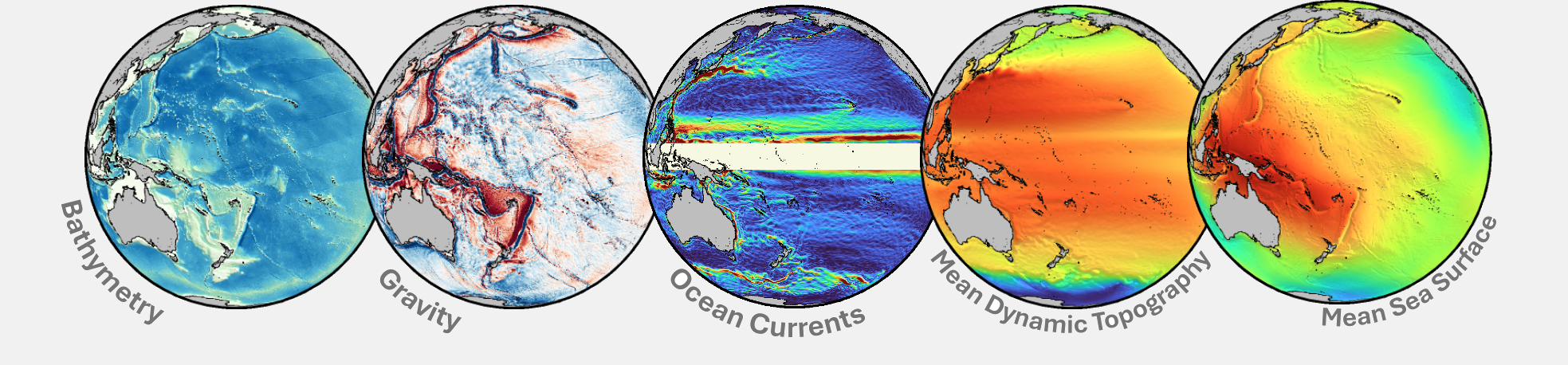
Advancing global reference surfaces with SWOT
The group produces and maintains several global reference surfaces, including the Mean Sea Surface (MSS), Mean Dynamic Topography (MDT), and bathymetry. The integration of SWOT data into these products is expected to yield substantial improvements and represents an active area of research within our group.
x
x
Publications
Below you can find a list of our most recent publications, sorted by publication date.
x
x
Explore our research with the new SWOT mission
The newly launched Surface Water and Ocean Topography (SWOT) satellite (2022) for the first times measures water surface elevation as 2D images, revealing unprecedented detail and transforming the way we study water systems. Explore below examples of how the Hydro Group applies these observations across rivers, lakes, and the ocean.

SWOT Inland waters
SWOT in Copenhagen harbour
High resolution SWOT data show the effect of tidal locks in Copenhagen harbour.


SWOT in rivers
Floodwave captured by SWOT
SWOT observes a floodwave following the dam break of Kakhovka Dam in Ukraine.

SWOT cryosphere
SWOT detects iceberg breakups
SWOT can measure tsunami wave patterns generated as icebergs break up.

