Around the world glaciers are melting at an alarming rate
The world's glaciers have been decimated by global warming over the past 25 years, according to new research to which DTU has contributed. The research estimates that 273 gigatons of ice - per year - have melted glaciers in Europe, South America, Southeast Asia, Africa, the Middle East, Iceland, and, especially, in the Arctic and Antarctic.
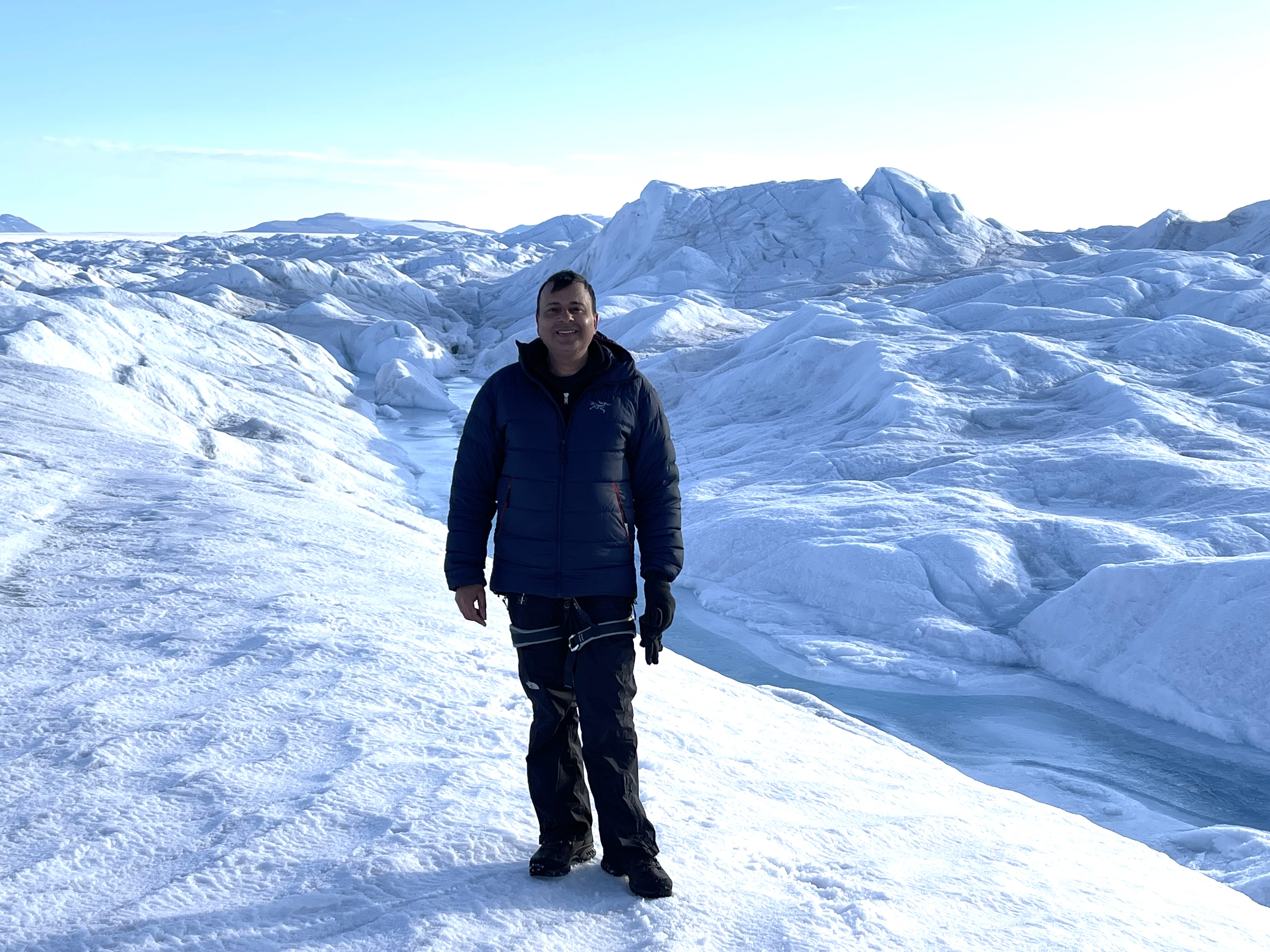
After Alaska, Greenland is the place on the planet where the most ice is disappearing from glaciers due to global warming. Photo: DTU Space.
Wednesday 19 February 2025
Morten Garly Andersen
Since 2000, as the global temperature has risen, glaciers across the globe have shrunk. This is true not only in the Arctic and Antarctic but also in the Middle East and South America, where large masses of ice in high mountain areas have existed for thousands of years.
In an extensive international research collaboration that DTU Space has contributed to, scientists have collected data from all the world's glaciers, calculated the melting based on different methods, and added them into the most accurate calculation of ice loss to date. Their results are published today in Nature.
"All methods unanimously show large melting of glaciers across the globe," says Professor at DTU Space Shfaqat Abbas Khan, who has been responsible for DTU's contribution to the new study and is head of the Center for Ice-Sheet and Sea-Level Predictions (CISP) funded by The Novo Nordisk Foundation and located at DTU Space.
Over the past roughly 25 years, it turns out 273 gigatons of ice have melted from glaciers each year. This is equivalent to approximately 273 cubic kilometres of water. If all this water were collected in Denmark, it would cover the entire country with a water column over 152 meters high.
"This is one of the most comprehensive studies of the total loss of ice from the world's glaciers to date. Not only has there been extensive melting from 2000 to 2023, it has also accelerated significantly during this period, so it is happening much faster today than 25 years ago," says Shfaqat Abbas Khan.
"We are seeing a trend where more and more areas are losing ice masses, which can have catastrophic consequences for local communities in the long term. Many rivers running through China, India and other parts of the Asian continent are supplied mainly by melting glaciers. So, a future lack of meltwater will affect crops and water supplies for people and animals, for example."
The researchers have measured glaciers across the globe, including in Greenland, where Professor Shfaqat Abbas Khan has taken field measurements. Photo: DTU Space.
19 glacier-areas ranked
Researchers at the University of Zurich and the University of Edinburgh lead the current study, which includes 19 areas with glaciers distributed across the Earth. The study is part of the Glacier Mass Balance Intercomparison Exercise (GlAMBIE) project, which aims to analyse all of Earth's glaciers.
On average, approximately 300,000 Olympic-sized swimming pools (each 50x25x2 meters) have been emptied daily from glaciers since 2000.
The most significant amount of glacier melt is found in Alaska, followed by Greenland and the Arctic part of northern Canada. However, somewhat surprisingly, the southern Andes Mountains in South America are the fourth largest contributor, while the Arctic of southern Canada is number five and Antarctica number six.
The meltwater from the glaciers since 2000 corresponds to a global sea level rise of around 18 millimetres.
While this contribution is significant, glaciers are only a lesser part of the total ice masses on the planet. The contribution to global meltwater from the ice caps that cover most of the Arctic and Antarctic is considerably larger. So, in addition to the 273 gigatons of ice that have melted annually from the glaciers, ice caps in the Arctic and Antarctic have lost 420 gigatons of ice annually over the same period. Hence, a total of 693 gigatons of ice has melted into the oceans every year since 2000.
Melting glaciers - top 11
The 11 areas with the highest annual glacier melt in the period 2000-2023 measured in gigatons per year: