Inland ice sheet deep within Greenland is now moving faster towards the coast
A comparison of new GPS measurements with unique 65-year-old data shows that the ice 100 km inland in Greenland is moving faster now.
Scientists have conducted new GPS measurements inland at Sermeq Kujalleq in western Greenland that reveal that parts of the ice sheet are moving 5-15 per cent faster now than 65 years ago.
Thursday 25 April 2024
Morten Garly Andersen
New GPS measurements reveal that parts of the inland ice sheet in western Greenland at Sermeq Kujalleq are moving between 5 and 15 per cent faster now, including towards the coast and the ocean, compared to 1959 when similar measurements were made without GPS.
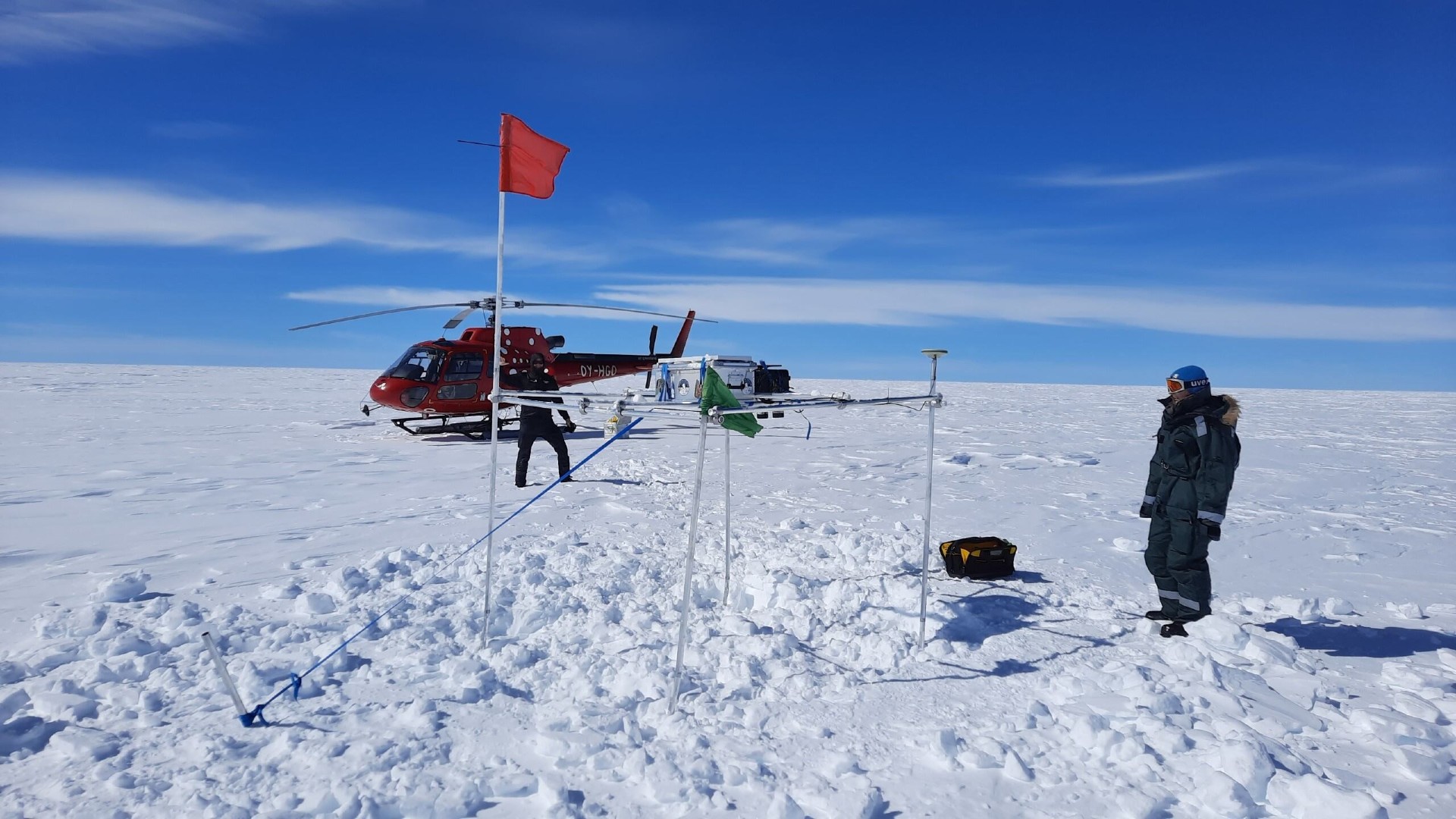
With contributions from DTU Space, researchers from GEUS have registered the ice's movement on the ice itself, on sites 100 km from the ice edge closer to the coast, through new GPS measurements. The measurements have been made in an area that is part of Sermeq Kujalleq, also known as Jakobshavn Isbræ.
"We know that Sermeq Kujalleq is moving at an extremely high speed, and we generally understand the movements and acceleration along the edge of the ice quite well because we have been able to document it. We assumed that the ice further inland was slower to react and move, but our new measurements show that this is not the case in this area," says Anja Løkkegaard.
Help from a GPS expert at DTU
Taking measurements in the actual area is logistically challenging, but it is important. GPS measurements on-site can provide something that cannot be obtained with satellite data, which are often used today to monitor the impact of climate change on the Greenland ice sheets and the world's oceans.
"It is very difficult to operate so far inland on the ice sheets, but measuring the ice speeds there on-site via GPS is important, as the satellite-derived speeds become less reliable further inland from the coast. With these GPS observations measured far inland on the ice sheet, we can now see an acceleration of the ice that satellites have not yet been able to detect," says professor Shfaqat Abbas Khan, who is internationally recognized as an expert in measuring ice movements and ice melting in Greenland.
Unique measurements from 1959
According to the researchers, the results of the study suggest that there are parts of the mechanisms in how the ice reacts to, among other things, global warming that are not yet fully understood and that further research is needed.
The researchers have made measurements of the ice's movement at a number of locations near Sermeq Kujalleq, which were selected because measurements of the ice's movement speed were made at the same locations 65 years ago back in 1959. The unique measurements at that time were made by placing sticks in the ice and later returning to measure how much they had moved.
The new measurements were made with very precise GPS equipment, but the researchers have taken into account the uncertainty in the old measurements, thus providing a solid basis for comparison between the two sets of data.