Datasets
This page provides access to datasets produced by the Hydrosphere Group at DTU Space.
Our group develops and maintains global reference surfaces such as the Mean Sea Surface (MSS), Mean Dynamic Topography (MDT), gravity fields, and bathymetry. The products are derived from a comprehensive suite of satellite altimetry missions and new high-resolution data from the SWOT mission.
In addition, we offer regional datasets with high spatial resolution.
Global products
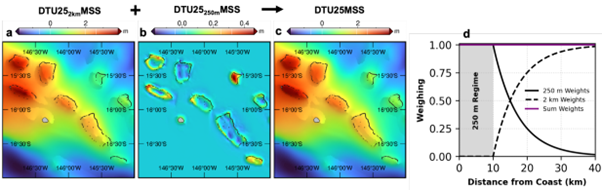
The mean sea surface is the displacement of the sea surface relative to a mathematical model of the earth and it closely follows the geoid. Amplitudes ranges between +/- 100 meters. The DTU25MSS is obtained from the Surface Water and Ocean Topography (SWOT) satellite, and a long timeseries of conventional altimetry. The DTU25MSS constrains long wavelengths (> 20 km) from conventional altimeters while utilizing almost 2 years of SWOT observations to reduce the short wavelength noise and incorporate previously unmapped geodetic features into the MSS. The MSS is extended to the coastal zone using the high-resolution 250 m SWOT data.
Download data
DOI: http://doi.org/10.11583/DTU.29412275
Reference: Nilsson, B., Andersen, O. B., and Knudsen, P. (2025). The DTU25 Mean Sea Surface: From and For SWOT, Earth Syst. Sci. Data Discuss. [preprint], https://doi.org/10.5194/essd-2025-404, in review
Contact
Bjarke Nilsson PhD Student bjarke@space.dtu.dk

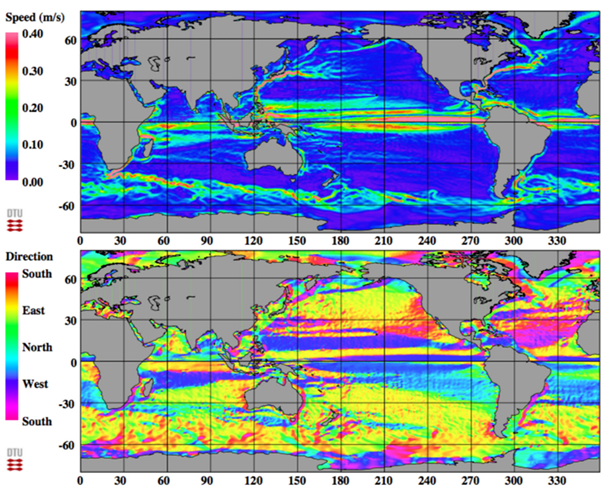
The mean dynamic topography (MDT) describes the differences between the time-mean sea surface and the geoid and reflect the mean circulation in the oceans. In this analysis the so-called geodetic mean dynamic topography model DTU22MDT is derived using the recent DTU21MSS mean sea surface. As geoid model the XGM2019e model complete to d/o 2160 was applied. The processing scheme used for deriving the geodetic MDT is based on spatial filtering for reducing errors. Subsequently, drifter velocities from in-situ buys are integrated to enhance the resolution of the MDT model. The final model DTUUH22MDT provide a state-of-the-art description of the 20 year mean global ocean circulation.
Download data
DOI: https://doi.org/10.11583/DTU.26947894.v1
Reference: Knudsen, P., Andersen, O.B., and Maximenko, N. (2021). A new ocean mean dynamic topography model, derived from a combination of gravity, altimetry and drifter velocity data. Advances in Space Research, Volume 68, Issue 2, https://doi.org/10.1016/j.asr.2019.12.001
Contact
Per Knudsen Professor pknud@dtu.dk
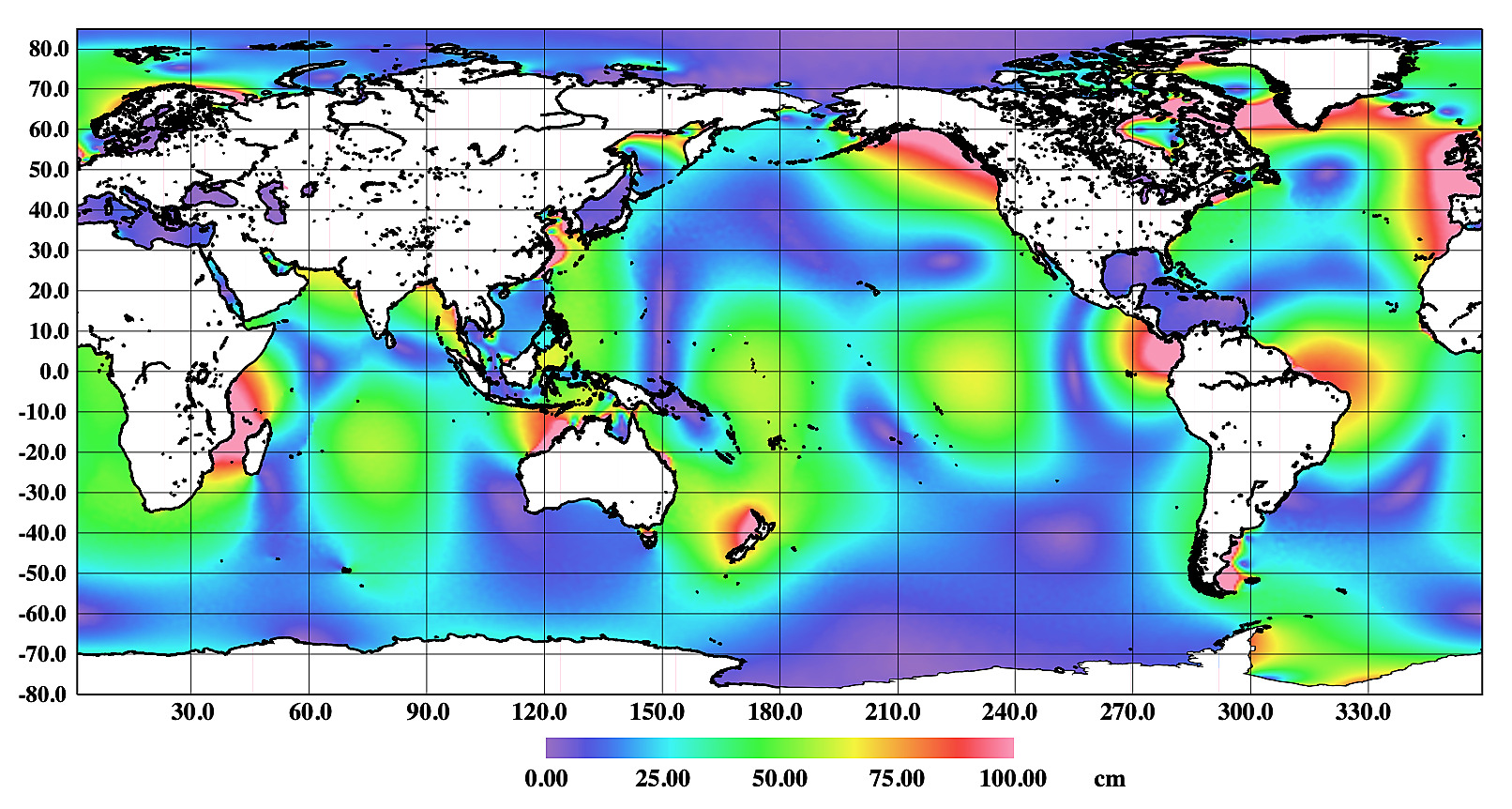
The DTU23 Global Tide Model is the newest version of the DTU global 1/6 degree ocean tide models derived from satellite altimetry given on similar resolution to the FES2014 ocean tide model. The spatial resolution is 1/16 degree corresponding to 6 km at the Equator. The model contains 10 constituents and is provided with interpolation software to deduce 30 additional minor tidal constituents.The model is mainly and update to the previous global ocean tide models (DTU16) in the polar regions.
Download data
DOI: https://doi.org/10.11583/DTU.23828874.v1
Contact
Ole Baltazar Andersen Professor oand@dtu.dk
Regional products
This product contains 2 km resolution gridded maps of ocean topography (ADT), geostrophic currents, and relative vorticity from assimilation of SWOT and nadir altimetry in the Nordic Seas east of Greenland. The products are derived by assimilating the data in a 1.5 layer quasi-geostrophic model using the BFN-QG algorithm (https://github.com/leguillf/BFN-QG). The products cover the ice-free ocean and the marginal sea ice zone.
Download data
DOI: https://doi.org/10.11583/DTU.29664665.v1
Reference: Jensen, S. N., Andersen, O. B., Ludwigsen, C. B., Gonçalves-Araujo, de Steur, L. (2025). Surface Water and Ocean Topography (SWOT) Observations Unveil Small Mesoscale Variability on the East Greenland Shelf. Geophysical Research Letters, 52 (21), doi:10.1029/2025GL118573
Contact
Sara Nielsen Jensen Research Assistant sanje@dtu.dk
