Quantum Gravimetry


Contact
Tim Enzlberger Jensen Senior Researcher timj@space.dtu.dk
René Forsberg Professor rf@space.dtu.dk
Adequade
The project is funded by the European Defense Fund (EU-EDF). More information can be found on the project website: https://adequade.eu/
EQUIP-G
The main tasks of DTU are related to demonstrating climate monitoring, consisting of repeated measurements in Greenland, and two airborne campaigns using both a fixed-wing aircraft and an airship carrier.
An important aspect of the project is the inclusion of the entire European community through dissemination, communication and workshops, including two training workshops with hands-on exercises. The project is funded by the Horizon Europe programme.
CARIOQA-PMP
The Cold Atom Rubidium Interferometer in Orbit for Quantum Accelerometry – Pathfinder Mission Preparation (CARIOQA-PMP) aims to pave the way for Cold Atom Rubidium Interferometry (CAI) in space. During the preparation of the CARIOQA-PM, the CAI technology is developed further and a roadmap for quantum space gravimetry missions is established. DTU Space is involved in the analysis and simulation of potential mission scenarios for the Quantum Pathfinder Mission and future Post-Pathfinder scientific missions.

Green Quantum
AirQuantumGrav
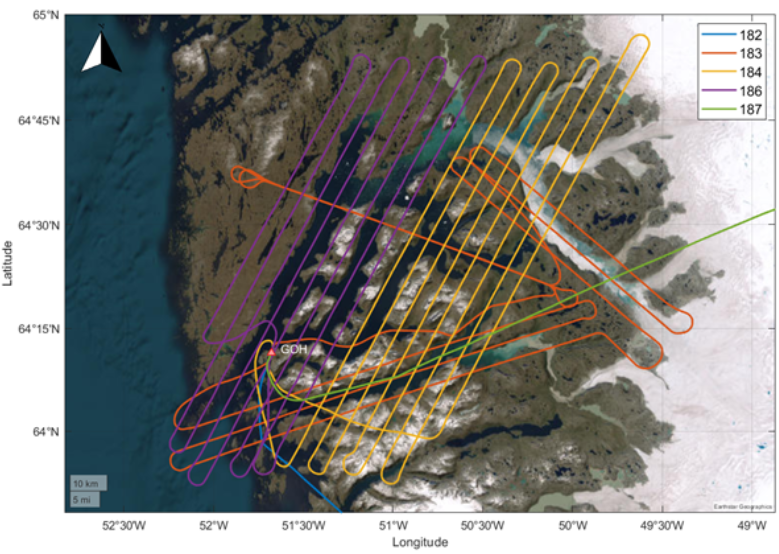
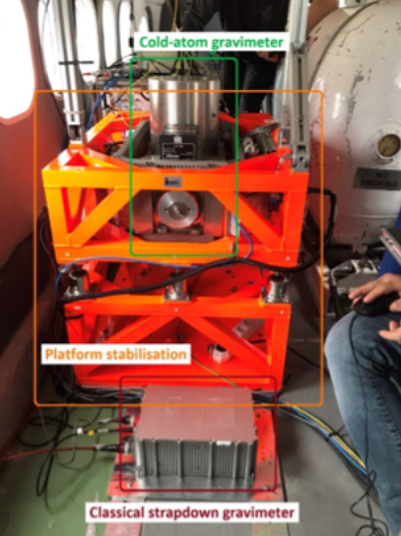
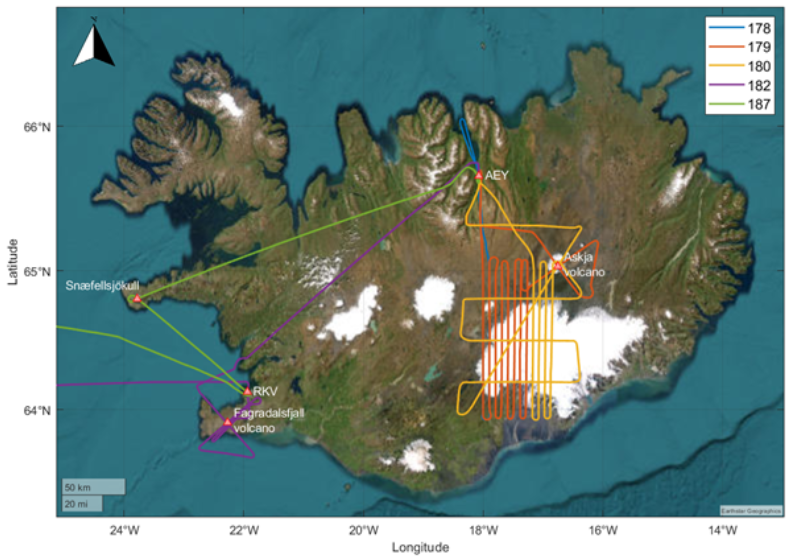
The aim of AirQuantumGrav project was to validate the benefits of quantum technology for airborne gravimetry. The project consisted of an airborne survey in Iceland carried out in combination with the Green Quantum survey. The survey lines mainly targeted areas of known mass variations: (1) Repetition of the 2017 survey over the Vatnajökull ice cap; (2) overflying the Askja volcano which is associated with rapid uplift rates; (3) overflying the Fagradalsfjäll volcano which had several recent eruptions; and (4) repeating a survey line between Snæfjellsjökull and Akureyri, which was also surveyed in 2017. The project was funded by the European Space Agency (ESA).
Link to project page: https://doi.org/10.57780/esa-58c58c5
Airborne Survey of French Biscay and Pyrenees
Airborne Survey in Iceland
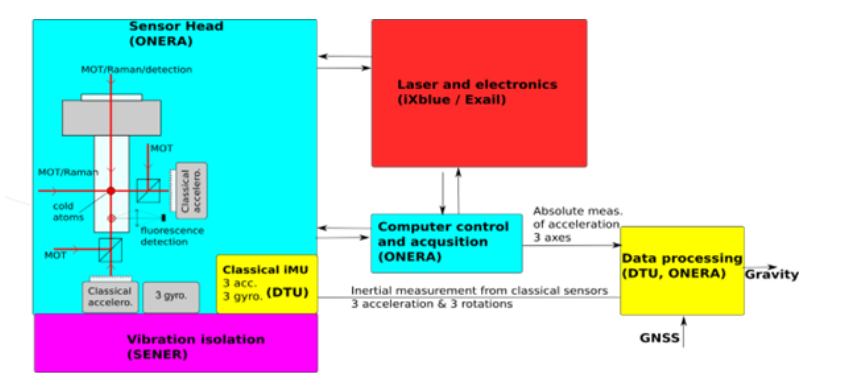
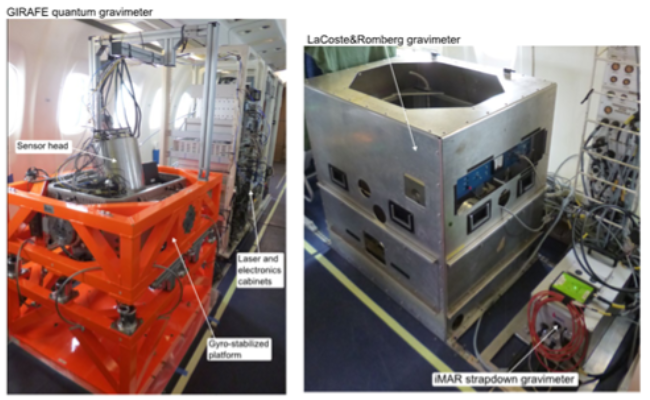
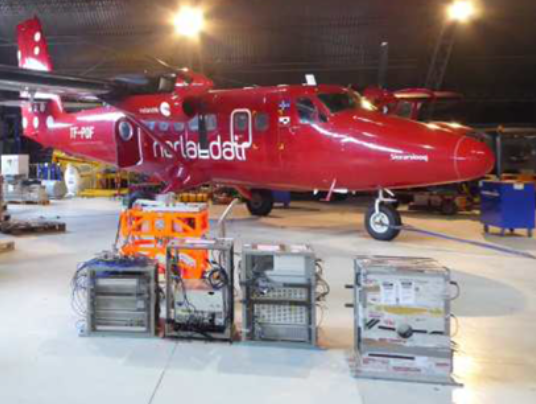
The 2017 airborne survey in Iceland was the first demonstration of airborne gravimetry and was funded by the European Space Agency (ESA). The aim of the project was to test the GIRAFE quantum gravimeter developed by ONERA in an aircraft. The GIRAFE instrument was originally a research instrument, funded by the French Navy, aimed at marine gravimetry. This project therefore represented the first step in the evolution from a marine instrument to an airborne instrument.
Link to project page: https://doi.org/10.57780/esa-b0ed0a3
Publications
- Jensen, T. E., Dale, B., Stokholm, A., Forsberg, R., Bresson, A., Zahzam, N., Bonnin, A., and Bidel, Y. (2025).Airborne gravimetry with quantum technology: observations from Iceland and Greenland, Earth Syst. Sci. Data17: 1667–1684, https://doi.org/10.5194/essd-17-1667-2025.
- Vu, D.T., Bonvalot, S., Seoane, L. et al.(2024). Potential of cold-atom airborne gravimetry to improve coastal gravity field and quasigeoid modelling. J Geod98: 28. https://doi.org/10.1007/s00190-024-01839-0
- Bidel Y, Zahzam N, Bresson A, Blanchard C, Bonnin A, Bernard J, Cadoret M, Jensen TE, Forsberg R, Salaun C, Lucas S, Lequentrec-Lalancette MF, Rouxel D, Gabalda G, Seoane L, Vu DT, Bruinsma S, Bonvalot S (2023) Airborne absolute Gravimetry with a quantum sensor, comparison with classical technologies. J Geophys Res Solid Earth128(4):e2022JB025921. https://doi.org/10.1029/2022JB025921
- Bidel, Y., Zahzam, N., Bresson, A. et al.(2020). Absolute airborne gravimetry with a cold atom sensor. J Geod94: 20. https://doi.org/10.1007/s00190-020-01350-2